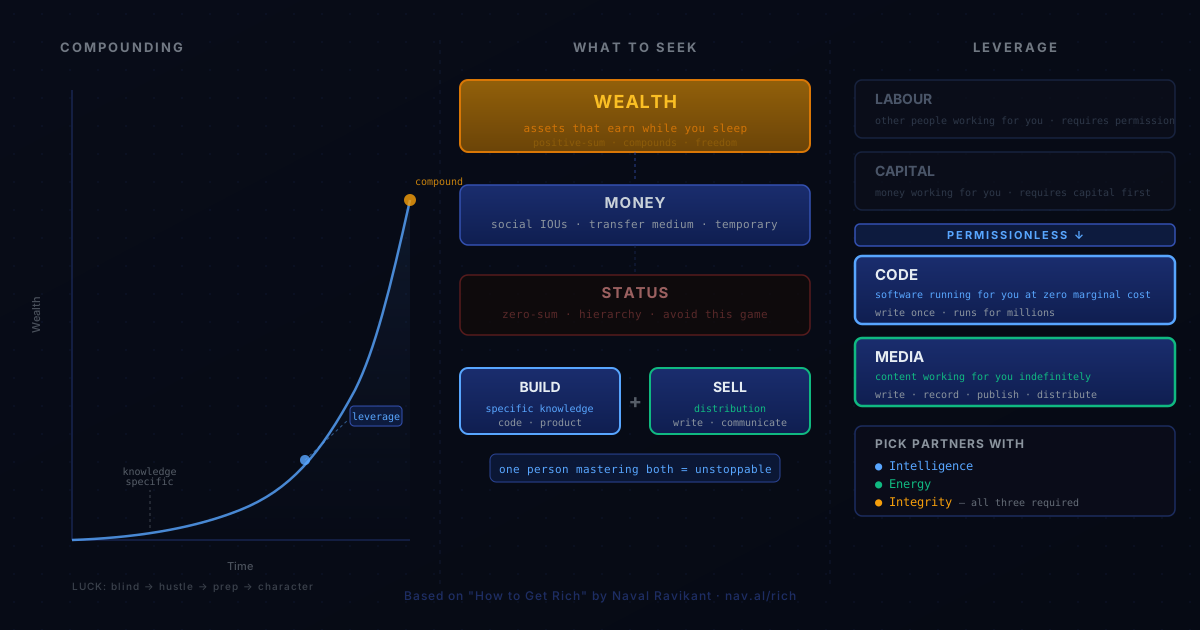
Disclaimer: This post is part of a personal learning series based on Naval Ravikant’s “How to Get Rich” transcript, available at nav.al/rich. The ideas and frameworks here belong to Naval — I’m working through them for my own understanding. This is not financial advice.
Strategy, leverage, and specific knowledge are built individually. But wealth at any meaningful scale is built with people, over time. The final layer of Naval’s framework is about who to build with, how trust compounds when you play long games, and how to develop the intellectual foundation that makes everything else possible.
Play Long-Term Games With Long-Term People
Naval’s observation about compound interest extends far beyond money: all the benefits in life come from compound interest — in relationships, in knowledge, and in reputation, not just in investments.
The reason long-term games compound is game theory. In a one-shot interaction, the rational move is often to defect — extract maximum value and move on, because there are no future rounds to lose. In a repeated game with the same people, the rational move is to cooperate, because both sides know the game continues. Trust develops precisely because both parties have skin in future iterations.
This dynamic is what Naval points to when describing Silicon Valley’s productivity. Long-term geographic proximity — encountering the same people across companies, across deals, across decades — changes how people behave toward each other. Reputation follows you. Defection in round one affects every subsequent round. The result is a tit-for-tat equilibrium where cooperation is the dominant strategy, not because of idealism but because of rational self-interest across a long time horizon.
In long-term games, everyone makes each other wealthier — positive sum. In short-term games, people divide what already exists — zero sum. The type of game you’re playing determines what strategy is rational.
The corollary is the cost of switching too frequently: every time you reset your context — new industry, new city, new network — you start compounding from zero. The trust you’ve built, the reputation you’ve earned, the relationships that took years to develop don’t transfer. They compound in place. People who switch industries and geographies repeatedly never benefit from the long tail of compounding that comes from sustained presence in one domain and community.
Pick Partners With Intelligence, Energy, and Integrity
Naval’s partner selection framework is three non-negotiable traits:
Intelligence — seeing problems clearly, acting in the right direction, making sound decisions under uncertainty.
Energy — actually executing. Showing up, doing the work, sustaining effort over the duration needed for things to compound.
Integrity — not cheating you when it becomes advantageous to do so.
All three are required. Any two without the third is dangerous. High intelligence and high energy without integrity produces “a smart and hardworking crook who’s eventually going to cheat you.” The smarter and more energetic they are, the more thoroughly they can cause damage when their interests diverge from yours. Integrity is the constraint that makes the other two safe to rely on.
The difficulty is that integrity is the hardest trait to verify upfront. People present well in early interactions. The tell is how they behave when they think no one is watching: how they treat people with less power than them, how they handle situations where cutting corners would benefit them, whether they hold grudges out of proportion to the offence, whether they speak badly about people who aren’t in the room.
These patterns are consistent. The person who treats a waiter dismissively will eventually treat you dismissively. The person who rationalises cheating a previous employer will find a rationalisation for cheating you when the circumstances align. You cannot manufacture high-integrity behaviour through incentives. It either exists in someone’s character or it doesn’t.
Intrinsic Motivation Cannot Be Manufactured
A related principle: you cannot sustainably motivate another person through external pressure. Motivation has to come from within. This matters for choosing collaborators because people who are genuinely excited by what they’re building — who would work on it regardless of the specific compensation — sustain output over the long run in a way that externally motivated people don’t.
External incentives produce performance while the incentive is present. Remove it and performance returns to the intrinsic baseline. If that baseline is low, you’ve built a dependency rather than a partnership.
The practical consequence: look for people who find the problems genuinely interesting, not primarily those drawn by the package. Their motivation compounds over time. Everyone else’s degrades.
Partner With Rational Optimists
Pessimism is the comfortable position. Pointing out why something won’t work requires no execution and insulates you from the embarrassment of trying and failing publicly. Naval identifies the specific failure mode: the cynic who won’t lead, won’t follow, and won’t get out of the way — blocking progress without contributing any direction.
The alternative isn’t naive optimism — ignoring real risks and charging forward on enthusiasm. It’s rational optimism: seeing reality clearly while maintaining confidence in your ability to navigate it.
“Know all the pitfalls. Know the downsides, but still keep your chin up.”
Naval grounds this in evolutionary reasoning. Humans evolved as pessimists — acute threat sensitivity kept our ancestors alive. But the risk structure of the modern world is fundamentally different: limited downside, potentially unlimited upside. Taking a bet that costs you a year of effort but could generate decade-long returns is rational. The evolved pessimism response — avoid the bet — is no longer calibrated to the actual risk environment.
The only thing genuinely worth avoiding is ruin: paths that lead to catastrophic, irreversible loss — bankruptcy, jail, permanent reputation damage. Everything short of that is recoverable. Rational optimists understand this distinction and take the bets. Pessimists avoid all of them to preserve the feeling of safety.
One more observation: successful people “just do things.” The fastest way to determine whether something is viable is to try it. Doing is faster than planning, and far faster than watching.
Read What You Love Until You Love to Read
The intellectual foundation of the entire framework is reading — not as a performance but as a compounding habit that changes how you think over years and decades.
The barrier most people face isn’t access to books. It’s that they haven’t built the habit itself. Naval’s solution to the catch-22: read what you love until you love to read. Start with fiction if that’s what holds attention. Move to science fiction, then narrative non-fiction, then denser material, then primary scientific and philosophical texts. Follow genuine interest rather than a curated syllabus.
What to read once the habit exists matters. Naval is specific: read foundational texts over modern commentary. Adam Smith’s Wealth of Nations rather than business school summaries. Darwin’s Origin of Species rather than popular science books about evolution. Feynman’s Six Easy Pieces rather than cosmology written for a general audience.
The reason is fidelity. Every layer of commentary filters, selects, and interprets what came before. Reading the original means encountering the argument as its author constructed it — not as someone else decided to summarise it. You build mental models from primary sources, which are defensible from first principles. Memorised conclusions from secondary sources are not.
Depth over volume. It is better to read one book slowly, struggling with difficult passages, sitting with ideas until they become part of how you think, than to skim fifty books and accumulate the count. The goal is not to have read things — it’s to understand them well enough that the insight is available when you need it. That only happens through genuine engagement.
Mathematics and Logic Are the Bedrock
Underlying everything else: mathematics and logic. Once you’ve internalised mathematical thinking, you can evaluate any field’s claims from first principles rather than memorising expert opinions. You can follow a statistical argument to its assumptions, identify what’s being asserted versus what’s been demonstrated, and separate truth from opinion dressed as fact.
This is the difference between genuine understanding and accumulated information. Someone with mathematical fluency reads a study and evaluates the methodology. Someone without it has to trust the presenter’s summary — which may or may not be accurate.
Five skills Naval considers foundational for operating effectively in the current world: reading, writing, arithmetic, persuasion, and computer programming. Not a specific domain. Not a specific credential. Five general capabilities that make every other form of learning faster and every other skill more deployable. Master these and the specific content of your career remains flexible across decades.
The full framework, taken together: define wealth correctly, engineer the conditions for luck, build ownership not just income, develop specific knowledge through genuine curiosity, deploy it through permissionless leverage, play long games with high-integrity people, and compound your understanding through deep reading. None of it is a shortcut. All of it compounds.
Part 5 of 5. Start from the beginning with Part 1: Wealth, Money, and Status.
Full original transcript: nav.al/rich