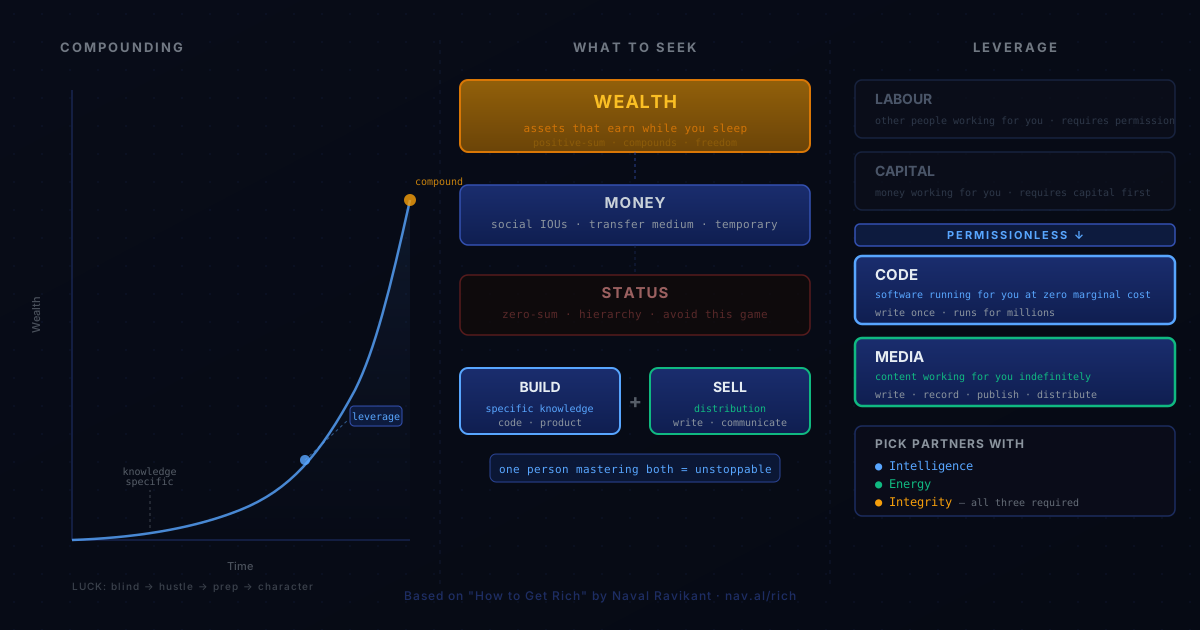
 Part 1 of How to Get Rich Without Getting Lucky →
Wealth, Money, and Status: Getting the Definitions Right
Disclaimer: This post is part of a personal learning series based on Naval Ravikant’s “How to Get Rich” transcript, available at nav.al/rich. The ideas and frameworks here belong to Naval — I’m working through them for my own understanding. This is not financial advice.
Most conversations about money collapse three distinct things into one word. Naval Ravikant’s framework starts by separating them cleanly, because until you define what you’re actually chasing, you can’t build a coherent strategy to get there.
Wealth Is Assets That Earn While You Sleep
Naval’s definition is precise: wealth is assets that earn while you sleep — businesses, investments, intellectual property. Not your salary. Not your net worth as a number on a screen. Productive assets that generate returns independently of your time.
This definition rules out money earned by showing up. It rules out status. It points exclusively at things that compound without your direct presence. A business you own that generates profit while you’re on holiday is wealth. A bonus you earned by working 80-hour weeks is not — you traded time for it once and it won’t repeat without more time.
The goal behind wealth, in his framing, isn’t luxury. It’s freedom:
“So you don’t have to wear a tie like a collar around your neck. So you don’t have to wake up at 7:00 a.m. to rush to work.”
Sovereignty over your own time. That is the operative target.
Money Is a Social IOU
Money is the transfer mechanism for wealth — a claim on human effort that can be redeemed for goods, services, or productive assets. When you earn a salary, you accumulate transferable claims on society. Spend them on consumption and they’re gone. Convert them into assets and they compound.
The critical insight is that money is a means, not an end. People who confuse accumulating money with building wealth often end up with large account balances and no passive income. They have stored claims but nothing producing new ones.
Status Is Zero-Sum
Status is your rank within a social hierarchy. Unlike wealth, it is strictly zero-sum. For you to rise in status, someone else must fall. Every status point gained is, by definition, a status point lost by someone else.
Wealth creation is the opposite — positive-sum. A software product built by one engineer can serve millions of people simultaneously. The engineer becomes wealthier, users get something useful, and no one loses anything in the exchange. Value was created, not redistributed.
This distinction explains a real pattern: people who attack successful individuals are almost always playing status games, not engaging with economic reality. Dragging down someone wealthy does not make you wealthier. It moves someone lower in the hierarchy, which moves you up relatively. Naval is direct about this — it’s status-seeking disguised as moral positioning.
Recognising the pattern means you can ignore the attacks. They’re irrelevant to building actual assets.
Ethical Wealth Creation Makes the World Better
Naval rejects the idea that wealth is extracted from others. Historical wealth creation — antibiotics, electricity, cars, smartphones — generated genuine abundance. The people who built those things got rich, and the world got better. Neither outcome was at the expense of the other.
His thought experiment: if everyone had the engineering skills to build software and hardware, society would achieve enormous abundance with minimal required labour. Wealth creation at its core is building things that solve problems at scale. The builder captures a fraction of the value generated for others; the rest belongs to the world.
The corollary is what happens when the balance tips. When takers outnumber makers, productive capacity shrinks and systems deteriorate — not because wealth is unfair, but because the incentive to create disappears.
Free Markets Emerge From Human Nature
Naval argues that voluntary exchange and credit-debit tracking are evolutionary traits, not political inventions. Humans uniquely cooperate across genetic lines — we form relationships, track obligations, and trade with strangers because we developed the capacity to maintain mental ledgers of who owes what to whom.
Markets formalise this instinct. The mechanism by which billions of people coordinate effort and allocate resources without central direction is not a social construct imposed from above — it’s the formalisation of something humans already do naturally.
What This Means in Practice
Before building any strategy, it helps to be clear about what you’re actually trying to build:
- Wealth — assets earning independently of your time. The actual goal.
- Money — the transfer medium. Useful, but transient unless converted into assets.
- Status — social hierarchy rank. Zero-sum, mostly irrelevant to financial freedom.
The game worth playing is wealth creation. Misaligning on these definitions leads to building the wrong things — engineers optimising for prestigious titles instead of equity, founders chasing recognition instead of revenue, professionals maximising salary instead of ownership. All of them are playing a version of the status game while believing they’re on the wealth track.
The framework starts here because everything else — leverage, specific knowledge, long-term games — only works if the target is right.
This is Part 1 of 5. Continue with Part 2: The Luck You Can Engineer.