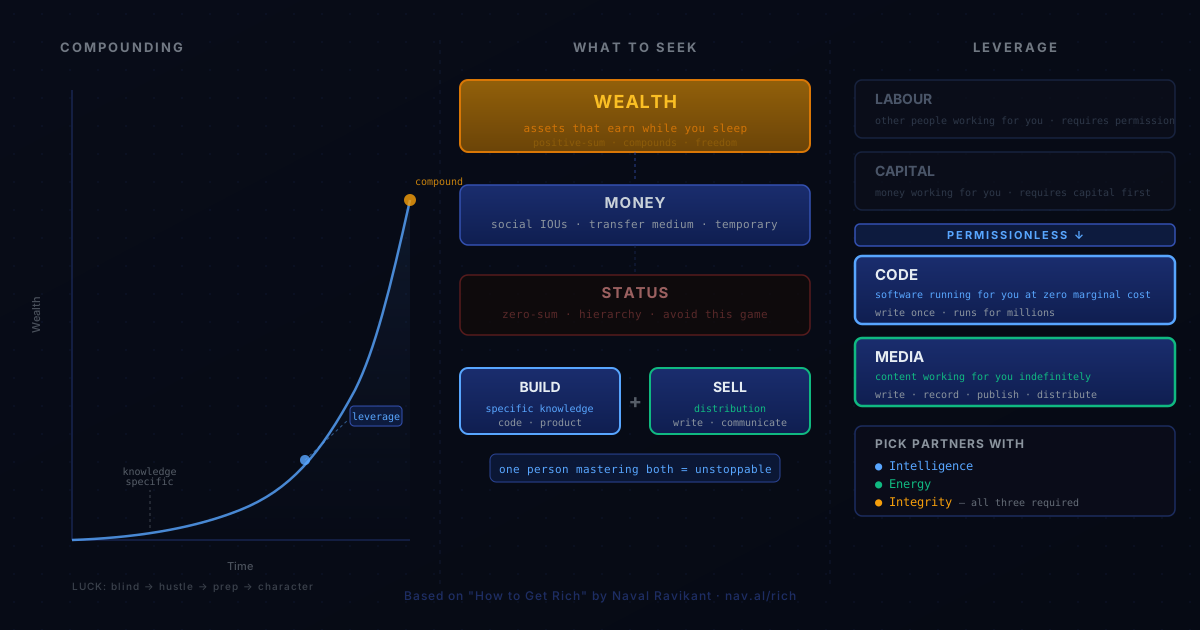
Disclaimer: This post is part of a personal learning series based on Naval Ravikant’s “How to Get Rich” transcript, available at nav.al/rich. The ideas and frameworks here belong to Naval — I’m working through them for my own understanding. This is not financial advice.
The phrase “how to get rich without getting lucky” sounds like a contradiction. But Naval’s argument is more precise than it first appears — not that luck doesn’t exist, but that there are four distinct types, and most of the ones that matter are ones you can engineer through deliberate effort.
Four Types of Luck
1. Blind luck. Pure chance. Lightning strikes, you happen to be in the right place. You have no influence over it, and it’s the least interesting type for building wealth — you can’t optimise for it.
2. Luck from hustling. You increase your exposure to opportunity by staying in motion — shipping projects, taking meetings, reaching out, trying things. Naval uses the image of stirring a petri dish: the more you stir, the more reactions you create. More activity expands your surface area for things to happen. This type is fully controllable.
3. Luck from preparation. You develop expertise deep enough that you recognise opportunities others miss. Two people encounter the same situation; one sees nothing, the other sees a breakthrough. The difference is pattern recognition built from sustained, focused work. Preparation doesn’t create luck — it lets you catch it when it passes.
4. Luck from character. You build a specific reputation and identity over time until opportunities seek you out. If you become known as the world’s best expert in a narrow domain, people with relevant problems will find you. The opportunity arrives because of who you are, not what you happened to be doing that day.
The progression is the point. Each type is more controllable than the last. The fourth type becomes so reliable it stops functioning like luck at all.
The 999 Out of 1,000 Framework
Naval frames the goal as: in 1,000 parallel universes, you want to be wealthy in 999 of them. Not all of them — some unlucky outcomes are genuinely unavoidable. But 999 out of 1,000.
That target requires building yourself so thoroughly that luck becomes marginal. The fourth type — character-driven luck — starts becoming deterministic. “Your character becomes your destiny.” When an opportunity arrives that requires your specific skills and reputation, you’re the only plausible candidate. The randomness is gone.
This connects character to outcome in a way most frameworks miss. Getting rich without getting lucky means building the version of yourself for whom wealth is a natural consequence, not a fortunate accident.
You Won’t Get Rich Renting Your Time
Even with the right kind of luck, you need the right vehicle. Salaried employment is the wrong one.
The structural problem is simple: inputs match outputs directly. Sleep, and you earn nothing. Vacation, and you earn nothing. Your output is capped by your hours, your hours are capped by your lifespan, and there is no mechanism for non-linear returns.
The deeper problem is replaceability. When you take a salaried role, you agree to perform a defined set of functions. Defined functions can be systematised, taught, and eventually automated. You’re filling a role, not expressing a unique capability. Your replacement is always findable.
Contrast this with leverage: one engineer creates Bitcoin and generates billions in value. Another engineer writes code that goes unused despite identical hours invested. The inputs are the same. The outputs differ by orders of magnitude. Salary compresses this variance deliberately — your pay doesn’t fluctuate with actual impact. That’s comfortable, and it’s also the mechanism that makes wealth creation through employment alone structurally impossible.
Ownership Is the Vehicle
The alternative is ownership — equity in something with productive potential. Stock options. Founding a company. Building something that generates returns without your continuous presence. Investing in assets.
Naval is unambiguous: “You must own equity, a piece of a business, to gain your financial freedom.” Not a higher salary. Not a better title. Equity — because equity is where upside is uncapped.
A salary has a ceiling negotiated in advance. Equity reflects what the business actually creates. If the business generates disproportionate value, your ownership stake reflects that. The ceiling doesn’t exist.
This doesn’t mean abandoning employment immediately. It means orienting every career decision toward increasing ownership of something — joining early-stage companies for equity rather than established ones for salary, building side projects with compounding potential, making investments. The vehicle matters as much as the effort.
Live Below Your Means — Preserving Optionality
There’s a companion principle: don’t inflate your lifestyle as your income rises.
Naval calls a monthly salary “one of the most dangerous drugs” — not because income is bad, but because predictable income trains you to spend up to it. As income rises, lifestyle expectations rise proportionally. The result is higher income with the same financial freedom — which is none. You’re running faster on a treadmill that also gets faster.
The alternative pattern is making money in discrete lumps separated over long periods, so your lifestyle baseline doesn’t have the chance to adapt. A founder who earns nothing for several years and then has a large exit hasn’t built the spending habits that a steadily rising salary would have created. They have optionality that a well-compensated employee — who spent every dollar as it arrived — doesn’t.
Freedom comes from the gap between what you earn and what you spend. Closing that gap through consumption eliminates the resource that funds the ownership path in the first place.
Accountability Is the Other Side of Ownership
Ownership requires accountability — your name attached to outcomes, good or bad. This discomfort is why most people avoid it. The downside is visible and real.
But accountability is also what makes ownership effective. When outcomes are tied to you specifically, you take the kind of care over your work that generates the best results. And it’s a market signal: founders with skin in the game attract better collaborators than those executing for a salary with no exposure to downside.
The combination — equity ownership, accountability, specific skills, lifestyle below means — is what separates the wealth track from the income track. Each element enables the others.
Part 2 of 5. Read Part 1: Wealth, Money, and Status or continue to Part 3: Specific Knowledge Is Your Moat.