Disclaimer: This post is part of a personal learning series based on Naval Ravikant’s “How to Get Rich” transcript, available at nav.al/rich. The ideas and frameworks here belong to Naval — I’m working through them for my own understanding. This is not financial advice.
Specific knowledge tells you what to build. Leverage tells you how that knowledge can generate returns that dwarf the time you put in. Without leverage, even exceptional skill produces linear returns — more hours, proportionally more output. With it, one unit of effort can multiply into thousands. This is the mechanism that separates income from wealth.
Give Society What It Doesn’t Know How to Get
Before getting to leverage itself, it helps to understand what you’re deploying it toward. Naval’s framing for identifying opportunity: find things society wants but doesn’t yet have a reliable way to obtain.
If society already knew how to produce something reliably, it would already exist at scale. The gap between what people want and what they can currently get is where value is created. Oil made Rockefeller wealthy because it solved lighting and energy problems that no existing infrastructure addressed. Cars made Ford wealthy because affordable personal transport didn’t exist. Each era has its equivalent gaps.
Creation alone isn’t enough though — distribution matters equally. Uber didn’t invent private drivers. It removed the friction in accessing them and made that access affordable at scale. The wealth came from solving both the product and the distribution problem. When you find your gap, the question isn’t just “can I build this?” but “can I scale it to the people who need it?”
The Four Types of Leverage
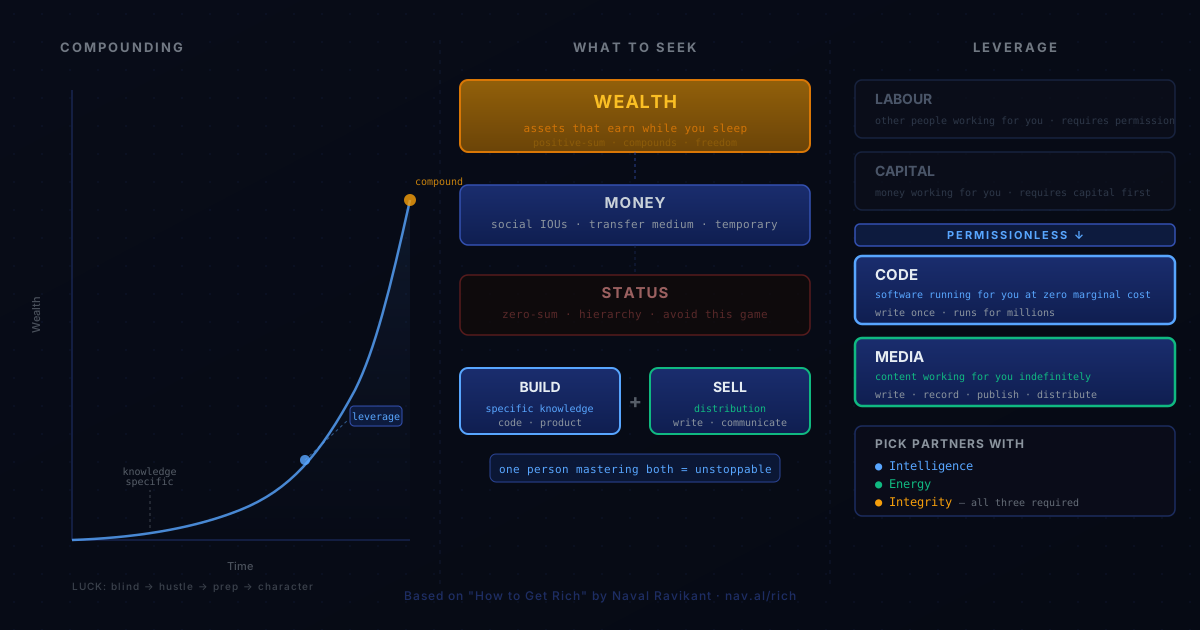
Leverage is getting outputs disproportionate to your inputs. Naval identifies four types, and understanding the differences between them matters practically.
Labour leverage — other people working on your behalf. The oldest form of leverage. A general commanding an army, a founder building a team. It scales, but slowly and expensively. Every person added requires hiring, onboarding, motivating, and coordinating. Managing people is a skill in itself, and it has hard limits. At some point, communication overhead consumes the gains.
Capital leverage — money working on your behalf through investments. More scalable than labour: once deployed, capital doesn’t need management in the same way. But it requires capital to start with, and the returns are heavily competed over by people with access to the same markets and information. Capital leverage alone tends to compress toward market returns over time. It’s powerful, but not distinctive.
Code leverage — software running on your behalf at essentially zero marginal cost per additional user. Write a program once; it runs for millions of people simultaneously. This is qualitatively different from labour and capital. The millionth user costs nothing more than the first. A single engineer’s output can serve a global user base without any proportional increase in effort. The upside is uncapped in a way that neither labour nor capital leverage achieves.
Media leverage — content working on your behalf. A blog post, a book, a podcast, a video — created once, distributable indefinitely. Joe Rogan records one conversation; it reaches tens of millions of people. The creator is asleep while the content is being consumed. Like code, the marginal cost of an additional listener or reader is zero.
Permissionless Leverage Is the Real Unlock
Naval draws a distinction that matters more than the specific type: permissionless leverage vs. leverage that requires permission.
Labour and capital leverage require permission. To hire, you need resources and someone willing to work for you. To deploy capital, you need capital — which means either earning it first or convincing someone else to give it to you. These require gatekeepers to say yes.
Code and media are permissionless. You don’t need someone’s approval to write software. You don’t need a publishing contract to write content. You don’t need an investor to start a YouTube channel or a blog. The barrier to accessing these forms of leverage is effort and skill, not permission.
This is new. For most of human history, meaningful leverage required institutional access — a factory, a printing press, a radio station, a bank. Those were expensive and controlled. The internet made code and media leverage available to anyone with a laptop and skill. This is the structural change that makes individual wealth creation more achievable now than at any point before.
The practical consequence: if you’re choosing where to develop skills, weight heavily toward domains where your output can be distributed digitally at zero marginal cost. Writing, software, video, audio. These are the leverage vehicles that don’t require permission to access.
What the Internet Did to Career Possibilities
Before the internet, your potential market was bounded by geography. Specialised expertise could only reach the people physically near you — your city, your industry, your local network. Most niche knowledge generated limited returns because the audience for it was too small in any one place to sustain a career.
The internet removes that constraint entirely. Any human is now reachable by any other human. Any niche obsession — obscure historical research, hardware hacking, competitive chess strategy, miniature cooking — can reach its global audience. The passionate 50,000 people worldwide who would pay for what you know are now findable. That number is often more than enough to build a sustainable livelihood around.
This has permanently expanded what a viable career looks like. E-sports players earn competitive salaries. Independent creators build audiences larger than cable news networks. Niche newsletter writers support themselves entirely through subscribers they’ve never met. None of these were structurally possible before the internet dissolved the geographic constraint on distribution.
The other change: the economics of niche are now better than the economics of generic. Serving a small passionate audience is more sustainable than competing for attention in a crowded mainstream category. Generic content fights for attention against everyone. Specific content finds the people for whom it is exactly right.
Authenticity Eliminates Competition
The usual advice for building an audience or a business is to find an underserved market and position competitively. Naval’s observation cuts past this: escape competition through authenticity.
Every human is a unique intersection of knowledge, experience, curiosity, and personality. No one else has yours. If you build around what you genuinely are — rather than optimising for what seems most commercially validated — you become irreplaceable by definition. The specific combination of you cannot be replicated, so competition converges to zero.
The trap is the opposite instinct: looking at what’s working for someone else and copying the format, the style, the positioning. That path leads directly into competition with the original, on their terms, where they have the advantage of being first and authentic to the approach. The thing that made them successful is that it’s genuinely theirs. Copying it makes you the imitation.
This is harder in practice than in principle because authenticity requires resisting a strong social pull. When something works for others, the obvious move is to do the same thing. Resisting that and building from your actual interests and strengths is the thing that generates genuine differentiation.
Taken together: find the gap society needs filled, build specific knowledge around it, deploy it through permissionless leverage (code or media), reach a global niche through the internet, and let your authentic combination of skills and perspective eliminate direct competition. Each element enables the others.
Part 4 of 5. Read Part 3: Specific Knowledge Is Your Moat or continue to Part 5: People, Character, and the Foundation of Learning.