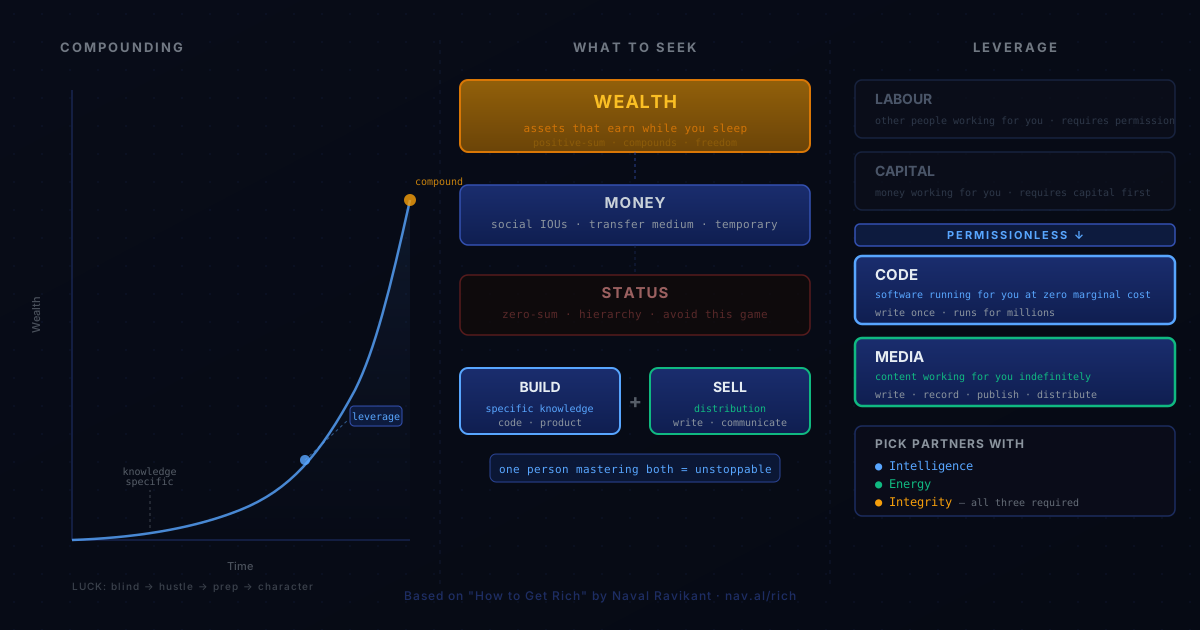
Disclaimer: This post is part of a personal learning series based on Naval Ravikant’s “How to Get Rich” transcript, available at nav.al/rich. The ideas and frameworks here belong to Naval — I’m working through them for my own understanding. This is not financial advice.
Once you understand what wealth is and why ownership matters, the next question is: what do you actually build expertise in? Naval’s answer is specific knowledge — and the definition is precise enough to be actionable.
What Specific Knowledge Is (And Isn’t)
Specific knowledge is expertise that cannot be formally taught, and therefore cannot be mass-produced, commoditised, or automated away.
The distinction Naval draws: everything can be learned, but not everything can be taught. Specific knowledge is developed through lived experience, genuine obsession, and working at the edge of a domain — not through standardised curricula. If a skill can be taught in a classroom, it can be certified, systematised, scaled, and eventually wage-compressed. The moment a skill becomes teachable at scale, it loses its economic scarcity.
This is why conventional career advice — study the high-paying field, get the credential, join the sector — often leads to exactly the outcome it promises initially but no more. You end up in a competitive pool of similarly credentialled people, competing on marginal differences.
Specific knowledge sits outside that pool because it can’t be replicated through the same pathway that created it in you.
How to Find Yours
The path Naval describes isn’t strategic — it’s introspective.
“Specific knowledge is found much more by pursuing your innate talents, your genuine curiosity, and your passion.”
The signal isn’t what sounds impressive or pays well. It’s what feels like play to you while appearing as work to others. If a domain pulls your attention regardless of external reward — if you’d explore it whether or not anyone paid you — that’s where specific knowledge forms.
There’s also an observational pattern: specific knowledge is often noticed by people who know you well before you’ve identified it yourself. Naval mentions his mother observing his entrepreneurial nature as a child — critiquing pizza parlour operations, noticing inefficiencies. He hadn’t framed it that way. She had. The people closest to you often see your specific knowledge before you do.
The practical test: find the intersection of what you’re obsessively curious about and what you can get better at faster than most people around you. That’s the seed.
Skill Stacking
You don’t have to be the world’s best at one thing. Naval references Scott Adams’ framework: being in the top 25% at three different skills creates a competitive advantage that doesn’t exist if you’re pursuing any one of them in isolation.
The combination matters more than the individual rank. A software engineer who is also an excellent communicator and has deep domain knowledge in a specific industry is rarer than three separate people occupying those positions. When the need for that intersection arrives, you’re the only candidate.
This also means specific knowledge can be assembled over time, across roles and domains, through genuine curiosity rather than linear credential accumulation. The unconventional path creates the unconventional combination.
Build and Sell — The Most Powerful Combination
Naval identifies the two fundamental skills of wealth creation:
- Building — creating products, writing code, designing systems, making things that work
- Selling — distributing, communicating, recruiting, fundraising, persuading
The most successful companies pair these in complementary founders. Jobs and Wozniak. Gates and Allen. One who builds deeply, one who sells effectively. The pairing works because each skill is genuinely hard, and most people are strong in at most one.
But one person who masters both becomes, in Naval’s word, “unstoppable.” Elon Musk understands rockets well enough to make credible commitments. Steve Jobs developed product intuition alongside distribution genius. Marc Andreessen programmed Netscape, then built the firm that funds the next generation.
The sequence Naval recommends: learn to build first, then learn to sell. Building requires sustained focus and is harder to acquire late. Selling — defined broadly as writing, marketing, communication, and persuasion — can be layered on later, particularly for people who are naturally communicative.
He goes further: “I’d rather teach an engineer marketing than a marketer engineering.” Technical depth provides better initial differentiation. Engineers who develop sales skills scale better over time than non-technical salespeople who attempt to understand what they’re selling.
Selling also doesn’t require hand-to-hand interaction. Writing is a form of sales. A clear technical blog post, a well-argued README, a compelling product page — these are all distribution. Engineers uncomfortable with traditional sales often find leverage through writing, which scales without continuous personal effort.
There Is No Skill Called “Business”
Naval is direct about this: “business” is too broad to mean anything, in the same way that “relating to humans” is too broad to be a skill.
Business schools teach case studies — anecdotes presented as analysis. The problem with anecdotes is that they can be assembled to justify almost any conclusion. Case study education produces pattern-matched intuition that breaks down in novel situations, which is precisely where most interesting business challenges arise.
The fields worth studying instead:
- Microeconomics — how individuals and firms make decisions under constraints
- Game theory — how strategic actors behave when outcomes depend on others’ choices
- Psychology — how people actually think and make decisions (rather than how they should)
- Persuasion — the mechanics of changing minds
- Ethics — not as philosophy but as a guide to sustainable decision-making
- Mathematics and logic — the foundation that lets you evaluate any domain’s truth claims
- Computing — the leverage tool of the current era
These are generative rather than descriptive. Understanding microeconomics lets you reason about any market. Understanding game theory lets you think through any negotiation. Understanding psychology applies everywhere. Knowing a specific case study from 1995 applies almost nowhere.
The deeper principle: doing is faster than watching. Building something, even something small, teaches more than an equivalent amount of time spent reading about what others built. First-principles understanding — built through doing — is defensible from any angle. Memorised facts from case studies are not.
Part 3 of 5. Read Part 2: The Luck You Can Engineer or continue to Part 4: Leverage, Scale, and the Internet.